Whether you are operating an enterprise, hyper-scale cloud, or multi-tenant data center, your infrastructure must address reliability, manageability, scalability, and flexibility. Without a flexible fiber optic cabling plan capable of easily accommodating common moves, adds, and changes, your network growth will be limited.
Sacramento Data Hall
Enterprise and Private Data Centers
The enterprise or private data center is the life source for many businesses. With e-commerce platforms, VPN services, and other programs supporting manufacturing, marketing, or HR, your network infrastructure needs to be reliable, flexible, and manageable.
New technologies and applications also drive the need for higher speeds, greater capacity, and lower latencies. Meeting data center standards, ensuring network scalability, and addressing the security challenges of today’s technologies are key to your enterprise data center network’s success.
The global data center market is expected to grow robustly in 2026 and beyond, with forecasts estimating annual industry expansion of around 14% through 2030, largely driven by artificial intelligence workloads, cloud services, and digital transformation initiatives.
Power and capacity builds are accelerating rapidly; industry projects suggest doubling of global data center capacity over the next several years.
Private equity and institutional investors are committing significant capital to data center platforms. For example, KKR is investing $1.5 billion into European data centers to support tailored facility builds for AI and cloud tenants.
Large M&A deals are occurring, such as a $40 billion consortium acquisition of Aligned Data Centers by BlackRock, Microsoft, Nvidia, xAI, and others, emphasizing AI-focused capacity growth.
Asset valuations remain elevated, and many operators and lenders expect continued high valuations through 2026.
Large Scale, Highly Portable, Flexible, and Scalable
Enterprise and private data centers are not “dying” in 2026—but they are being reshaped. They are fewer, more specialized, more expensive per MW, and increasingly hybrid by design, driven by AI, cost control, cloud repatriation, and regulatory pressure.
Multitenant Data Centers
Multitenant data centers (MTDC), also known as colocations, have various requirements for servicing end users. With an increased demand put upon data centers caused by the expansion of the Internet of Things (IoT) and its associated technology requirements, many infrastructures need upgrading to keep up.
The cost and resources involved in building a data center – as well as storing and managing the data – are immense. Additionally, keeping a data center fully optimized while eliminating latency, reducing downtime, and maintaining compliance with ever-evolving standards is quite challenging. by Alycea Ohl CorningOptical Communications
Private equity and institutional investors are committing significant capital to data center platforms. For example, KKR is investing $1.5 billion into European data centers to support tailored facility builds for AI and cloud tenants. Financial Times
Large M&A deals are occurring, such as a $40 billion consortium acquisition of Aligned Data Centers by BlackRock, Microsoft, Nvidia, xAI, and others, emphasizing AI-focused capacity growth.
Many traditional enterprise data centers (private on-premises facilities) are being divested or repurposed, with operators preferring colocation, cloud, or hyperscale facilities to handle AI, data analytics, and heavy compute workloads.
There is increasing emphasis on hybrid and edge architectures — combining centralized hyperscale facilities with distributed edge locations closer to end users for latency-critical applications.
Ai techniques for improving the performance of optical communication systems and networks. The use of Ai based techniques is first studied in applications related to optical transmission, ranging from the characterization and operation of network components to performance monitoring, mitigation of nonlinearities, and quality of transmission estimation.
·Faster Fiber Links for Data Centers
A new fiber-optic system can carry 800 gigabits of data per second, a big step up from top speeds of 100 or 200 gigabits in today's data centers.
Fiber-optic transmission capacity has grown at Moore's Law rates since the 1980s, helping to drive the rise of information technology. High-capacity long-haul systems have fueled network growth, most recently in the Pacific Light Cable. That system will carry a record 144,000 gigabits per second between Hong Kong and Los Angeles by sending 240 wavelengths through each of six fiber pairs when it comes online this year.
However, the bulk of data carried on those big cables is now moving between corporate data centers. Facebook and Google bought shares of the Pacific Light Cable to link their data centers in Asia and North America. Datacenter capacities are growing faster than 10 percent a year, stretching out among multiple buildings as the network transforms, says Helen Xenos, senior director of portfolio marketing for Ciena. Operators want to integrate cable networks connecting sites that may be tens of kilometers apart to look seamless to users.
Much data center traffic is packaged as 100-gigabit Ethernet transmitted on one of about a hundred wavelengths in an optical fiber. But operators want to squeeze more data through the cables. The number of ports installed in data centers to carry 200 gigabits or more is expected to increase more than 50 percent a year over the next three to five years, says Jimmy Yu, a vice president at the market research firm Dell'Oro group.
SINCE 1980, the number of bits per second that can be sent down an optical fiber has increased by some 10 millionfold. That’s remarkable even by the standards of late-20th-century electronics. It’s more than the jump in the number of transistors on chips during that same period, as described by Moore’s Law. There ought to be a law here, too. Call it Keck’s Law, in honor of Donald Keck. He’s the co-inventor of low-loss optical fiber and has tracked the impressive growth in its capacity. Maybe giving the trend a name of its own will focus attention on one of the world’s most unsung industrial achievements.
Moore’s Law may get all the attention. But it’s the combination of fast electronics and fiber-optic communications that has created “the magic of the network we have today,” according to Pradeep Sindhu, chief technical officer at Juniper Networks. The strongly interacting electron is ideal for speedy switches used in logic and memory. The weakly interacting photon is perfect for carrying signals over long distances. Together they have fomented the technological revolution that continues to shape and define our times. By Jeff Hecht | IEEE Spectrum
Most Popular Fiber Connectors (2025–2026)
TL;DR (Ranked by Use)
LC — #1 overall (dominates enterprise + data centers)
Increasingly used alongside LC fanouts rather than replacing LC [philisun.com]
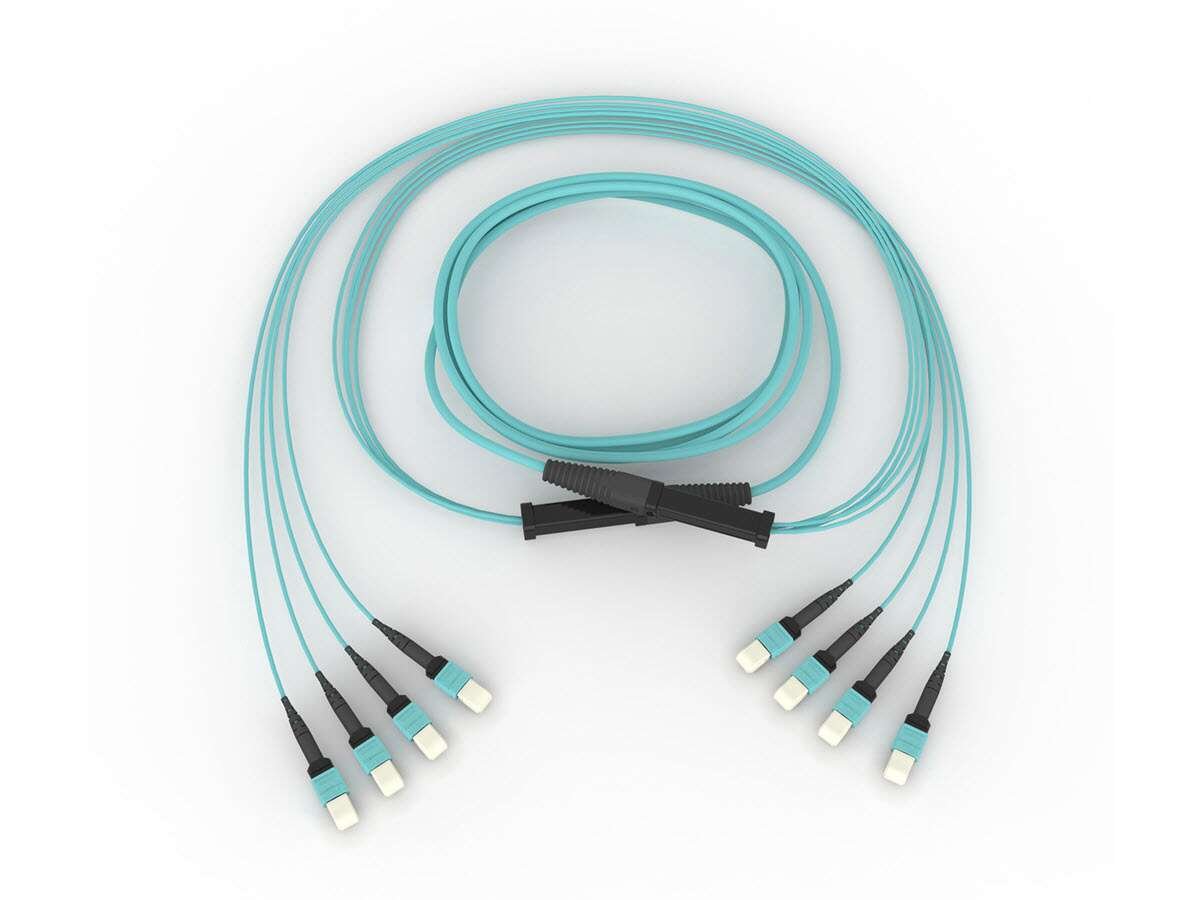
MPO is not a patch‑cord replacement — it’s a trunk/backbone connector.
Cleanstixx Swabs
SFP
Ball Lens
The advancements in optical transceivers: More data can be placed onto optical wavelengths. In return, we’ll see a higher rate of optical transceivers that operate with fewer fiber connections, benefiting our data center customers by reducing cable congestion within a rack and improving airflow.
Data Center Transceivers (2025–2026)
What a Transceiver Is (One‑Line)
A transceiver is a hot‑pluggable optical (or electrical) module that converts electrical signals ↔ light, defining speed, reach, fiber type, and connector.
1. Most Common Transceiver Form Factors (Ranked)
QSFP‑DD (Dominant for 400G / 800G)
Used for: 400G, 800G
Where: Hyperscale, AI clusters, core switching
Ports: LC or MPO
Status: Fastest‑growing form factor
SFP28
Used for: 25G
Where: Enterprise access, leaf switches
Ports: LC
Status: Still massively deployed
QSFP28
Used for: 100G
Where: Enterprise core, older hyperscale
Ports: LC or MPO
Status: Very mature, stable pricing
Others (declining or niche)
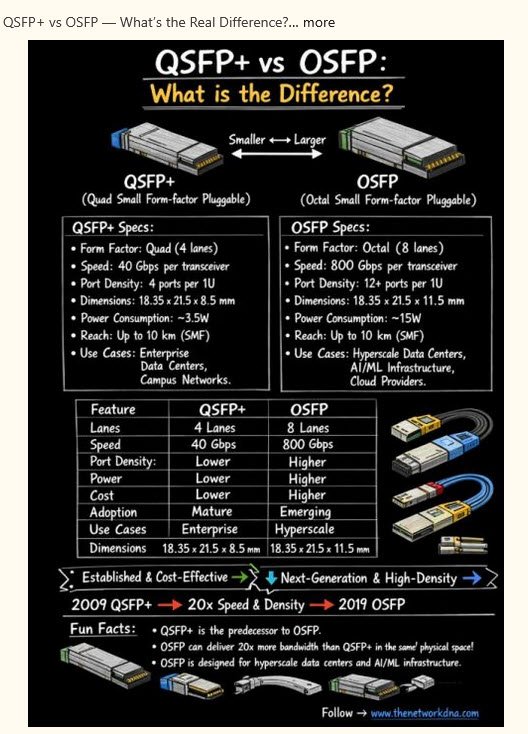
QSFP+ (40G) – legacy
SFP+ (10G) – still common but aging
OSFP – some 800G (mainly hyperscale)
Bottom Line
LC optics still dominate in sheer volume
MPO optics dominate new high‑speed builds
400G is the current mainstream
800G is hyperscale‑only (for now)
more info ... visit author The Network DNA @ https://www.thenetworkdna.com/
*** Inspect, Clean, and Re-Inspect ... 100% Spec Compliance ***
*HOT choice(s): The Sticklers Pro360 Touchless Cleaner
*Touchless Clean
*2100 Cleans per canister
*Go Anywhere
*Multiple Applications
*Cleans To the Ferrule
*Prevents Scratching and pitting
Still Trending and a HOT choice with Data Centers are the QSFP-DD and QSFP112. Both support up to 400 Gb/s in aggregate 4, respectively, over 8 lanes of 50 Gb/s and 4 lanes of 100 Gb/s electrical interfaces. The QSFP-DD800 5 supports up to 800 Gb/s in aggregate over 8 lanes of 100 Gb/s electrical interface. The QSFP-DD/QSFP6 DD800 cage and connector designs with 8 lanes are compatible with the 4 lanes QSFP28/QSFP112.
The 7 QSFP-DD800 cage and connector is an incremental design with enhanced signal integrity and thermal, which is 8 backward compatible to 8 lanes QSFP-DD and 4 lanes QSFP28. The QSFP112 cage and connector is a 9 incremental design with enhanced signal integrity and thermal, which is backward compatible to 4 lanes 10 QSFP28/QSFP+. The QSFP-DD800/QSFP112 supports up to 112 Gb/s (56 GBd) per lane electrical operation 11 based on PAM4 signaling and is expected to be compliant with IEEE 802.3ck [17] and OIF 112G-VSR [22] when 12 is published.
This overlap of key markets all wanting to deploy 400GbE simultaneously means the industry cannot spend the next five years optimizing form factors as it did for 100GbE. With every system vendor now building 400GbE products based on QSFP-DD, 400GbE will be the first speed transition where the initial form factor will also be the high-volume, dense form factor that can support all reaches and media.
There were some critical lessons learned from the 100GbE journey that should be applied to 400GbE. Even though a dense form factor called CFP4 was defined and built, it lacked backward compatibility with the dense 40GbE QSFP+ module and, as a result, was ignored. There is no reason to suggest something similar won’t happen in the 400GbE module market if we don’t learn from the past.
It’s important to consider how it was possible to extend the QSFP form factor from 40GbE to 400GbE, to better understand what’s possible beyond 400GbE.
Mark Npowell ... Cisco
Also, a HOT choice(s) is/are two new connector assemblies CS and SN from Senko and MDC from US Conec, which are 3.3 and 3.8 times smaller than the smallest connectors (LC) in use today. The advantage of these connectors is not the only form factor size. They also benefit from 4x less power loss and 4x the bandwidth (400Gb/s) than current standards allowing for much less power required by each of the transmitters (3.6W each down to ~1.3W)
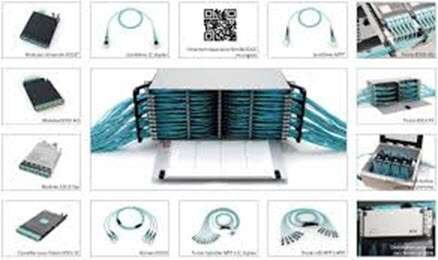
Also, a HOT choice is the Corning EDGE™ Rapid Connect™ Consolidator Frame
Corning-EDGE-Rapid-Connect
I've included below three noteworthy topics when it comes to incorporating intelligence into optical systems or networks: how to handle uncertainty, how to tackle decision-making, and how to learn.
... Artificial Intelligence in Optical Communications: From Machine Learning to Deep Learning ... Javier Mata
In an optical network, non-deterministic events occur, and the lack of full information about the environment is not a rare issue. Therefore, intelligent agents must be able to operate under uncertainty robustly.
A second key element is the use of decision-making algorithms.
The third issue of paramount importance is learning. Learning enables an agent to improve its performance on future tasks due to acquired experience.
Install Trunk Cables Between Data Centers up to 70% Faster
Enable fast; easy data center interconnects (DCI) deployments with the Corning EDGE™ Rapid Connect™ Solution – one step in Corning’s journey toward a Data Center in a Day.
Designed to facilitate DCI deployments and connections between data halls, EDGE™ Rapid Connect™ Solution utilizes trunk cables with the all-new Fast Track MTP® Connector. Developed by Corning and US Conec, the Fast Track MTP® Connector’s small profile enables pre-terminated trunks with a reduced diameter pulling grip that can be pulled through crowded conduits.
Want to pull over 10,000 connectorized fibers through a four-inch conduit, and complete the project faster than ever? Now it’s possible with EDGE Rapid Connect Solutions – available with outdoor-only, indoor-only, and indoor-/outdoor-compatible trunks.
Outside plant environments, the smaller two-inch diameter pulling grip allows EDGE™ Rapid Connect™ Solutions to be easily pulled through existing conduits – streamlining installation and giving data center operators a new path to extreme density. The grip is waterproof, capable of handling up to 600 pounds of pulling tension, and compatible with MaxCell Innerduct. Best of all, installation is straightforward – no special processes or equipment are required.
Understanding fiber polarity and how to connect and maintain a system with absolute certainty is key to a successful installation. The complex part, however, is there is no 'right' way to approach fiber polarity as each manufacturer usually provides its own fiber polarity solution.
Maintenance = Consult your supplier as needed
***Stickler's Cleaning Products are available at your favorite West Coast DISTY; EBAY; Google; or Factory Direct @ FiberRep
Inspect, Clean, and Re-Inspect ... 100% Spec Compliance ***
Sticklers FK08 High Volume Fiber Optic Cleaning Kit @ eBAY


 (Ai) Artificial Intelligence Impacts Network Polarity
 ·Faster Fiber Links for Data Centers

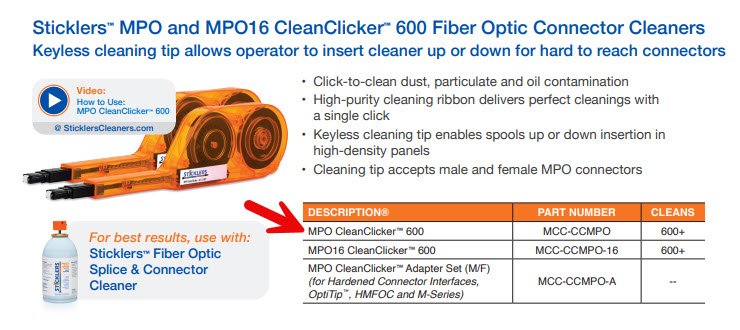
 Essential for high‑speed parallel optics


 QSFP‑DD (Dominant for 400G / 800G)
 SFP28
 QSFP28






Visit Wet/Dry Cleaning Solutions for adapter cleaning and end-face Cleaning for more product info.