Kingdomware Technologies, Inc., v. United States, No. 14-916 (2016)
In a nutshell, this new SCOTUS ruling has removed all major marketplace obstacles for VOSBs by “clarifying” the laws pertaining to their special status as listed herein.
A closer look at the Supreme Court Ruling (Ruling)
- The new Supreme Court ruling makes SDVOSB followed by VOSB the highest priority VA Set-Aside status. (Bertotti, Frank is a VOSB)
- The Supreme Court ruling gives higher priority to VOSBs and SDVOSBs than policies or mandates giving priority to the FSS (Federal Supply Schedule) or GSA.
- The Supreme Court Ruling supersedes any priority requirements of VAAR 808.002(a).
- The Supreme Court Ruling decided that “Orders” are still considered “Contracts” and are not exempt from their ruling.
- The VA must first perform a “Rule of Two” analysis and may only buy from a non-veteran source when the conditions of the “Rule of Two” are not satisfied.
- Contracting Officers must prioritize VOSBs by applying the Rule of Two under 38 U.S.C. § 8127(d)
- Supreme Court Ruling utilizes commanding and clear language leaving no room for optional compliance.
- A contracting officer must perform documented market research in an attempt to allow VOSBs and SDVOSBs a fair chance to compete for an opportunity.
I support these entities to the Fed/Gov Marketplace& Bertotti, Frank
WHAT IS THE VETERAN-OWNED SMALL BUSINESS (VOSB) CERTIFICATION?
VOSB certification verification is available for small businesses that are majority-owned and managed by a veteran who is directly involved in the day-to-day operations. With this certification, veterans gain a significant competitive edge for winning government contracts and attracting customers.
*** Veteran-Owned Small Business a.k.a. Bertotti, Frank VOSB Status: “VOSB certification currently inactive 2026”
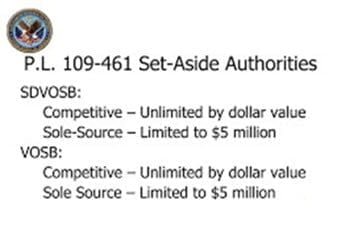
.... more about set-asides
The following information discusses numerous options in part but NOT ALL, for when to use or how to use set-aside or sole-source contract options. Discussion is necessary to determine the most appropriate path for your specific circumstances. That having been said, the following is intended to pique your interest in qualifying for Fed/Gov Contracts.
The federal government prefers to contract with small businesses whenever possible. Contracting officials use set-aside and sole-source contracts to help their agencies meet their small business contracting goals.
How a contract should be offered will depend largely on these factors:
- The number and type of small businesses that are able to do the work
- How much the contract is worth
- Determine if there are two or more businesses to do the work
- In general, if there are at least two small businesses that could do the work for a fair price, the contract should be set aside exclusively for small businesses to compete for.
- If there are fewer than two, you may be authorized to create a sole-source contract, or otherwise, you may offer it for full and open competition.
Common research methods include:
- Review recent procurement history
- Conduct market surveys
- Search on the Dynamic Small Business Search (DSBS)
- Get expert advice from an agency's small business specialist
- Get expert advice from the SBA’s Procurement Center Representative
- Consider the value of the contract
A Possible Waiver for Non-Manufacturer Rule
The Non-Manufacturer Rule?
For small business set-asides — Normally, other than construction or service contracts — the prime contractor that’s supplying products to the government is required to cover at least 50 percent of the cost of manufacturing those products.
The non-manufacturer rule is an exception to that requirement. The rule allows a small business to supply products it did not manufacture — as long as those products come from another small business.
See Title 13 Part 121.406 of the Code of Federal Regulations (CFR) for detailed information about the non-manufacturer rule.
Determining manufacturer or non-manufacturer A manufacturer is defined as a business that, with its own facilities, performs primary activities in transforming inorganic or organic substances, including the assembly of parts and components, into the end product being acquired. In other words, a manufacturer makes or produces products.
A business may qualify as a non-manufacturer if it meets these criteria:
-
Waivers to the rule
-
If the SBA determines that there no small business manufacturers available to supply a product, it may waive the non-manufacturer rule. There are two types of waivers: class and individual.
See 13 CFR 121 Subpart B for detailed information about waivers of the non-manufacturer rule for classes of products and for individual contracts.

This is NOT an offer or invitation to be your Manufacturer's Representative, Distributor, or Contracting Consultant. My preferred VOSB teaming methods are described herein.
Manufacturer's; OEM's; VAR's; Master Distributor; Installer Teams ... I can help YOU significantly by Teaming
Subpart 819.5—Set-Asides for Small Business
819.501-70 General principles for setting aside VA acquisitions.
819.502 Setting aside acquisitions.
819.502-2 Total small business set-asides.
819.502-3 Partial set-asides.
819.502-4 Multiple-award contracts and small business set-asides.