Cleaning a QSFP (+) or SFP (+)
The XMT fiber cleaning swabs from Sticklers™ are the industry’s best and least expensive MPO; QSFP+ connector cleaner.
This is a short video of cleaning a Ball Lens. Play several times to locate the end of the swab at the lens w/ball.
These large, flat, clean swabs are ideal for connectors with large, flat connector configurations, such as MTP, MPO, OptiTap drops and multiports, MT38999, MTRJ, QSFP+, and other MT-based transceivers.
They also are suitable for most MT-based backplane connector systems. Sticklers™' fiber swabs will get fiber networks running faster and more reliably than any other technology on the market today.
- Note, the hardness of the lens coating differs between transceiver types and manufacturers:
- Inspect and determine flat or ball lenses. You CANNOT clean a ball lens.
- If Flat, select the appropriate cleaning tool for the connector type. XMT = QSFP+ LC SFP + = SFP+
- Insert the cleaning tool into the transceiver port flat lens and clean with confidence. (see video if needed)
- RE-INSPECT and determine whether clean or dirty.
- If clean, the transceiver can be put into service.
- If dirty, repeat the cleaning process or replace the transceiver.
There are four form factors that are substantially more popular than the rest in the world of fiber connectivity. The original is SFP, and variations and improvements to the concept have been integrated over the years. The four incarnations that still see the most use are compared below.

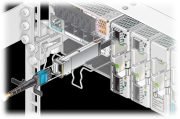
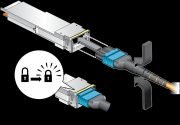
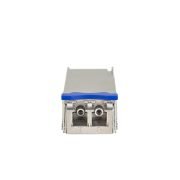
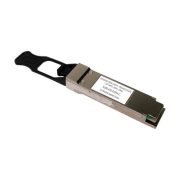
 Examples of QSFP associated with Oracle® Fabric Interconnect F2-12
-
The Oracle® Fabric Interconnect F2-12 uses QSFP+ (40 GbE) ports for uplinks and fabric connections.
-
Common compatible QSFP optics/cables include:
-
QSFP+ SR4 (MPO/MTP, multimode, short-reach)
-
QSFP+ LR4 (LC duplex via breakout, single-mode)
-
QSFP+ DAC (passive copper, short distances)
-
QSFP+ AOC (active optical cable)
-
Visual identifiers
-
Rectangular QSFP+ module with pull-tab latch.
-
MPO/MTP interface for SR4 optics; copper twinax ends for DAC.
-
Inserted into a 40 Gb QSFP cage on the F2-12 front panel.
SFP The acronym stands for “small form-factor pluggable.” As such, SFP connections are small and hot-pluggable. The connectors were originally designed to take up less space in crowded networks to allow for higher traffic density. They run on an LC interface and are half the size of the preceding GBIC form factor. SFP transceiver modules support SONET, Gigabit Ethernet, Fibre Channel, and other common interfaces. They can manage traffic from 1 to 10 Gbps across copper and fiber cables. This makes SFP one of the most versatile connectors on the market.
SFP+ The SFP+ takes the benefits of the SFP design and improves its data capacity. SFP+ still functions with copper and optical cabling, but it can achieve much higher speeds. Data rates start at 10 Gbps, and on the newer Fibre Channel design, SFP connections can hit speeds up to 32 Gbps.

XMT Cleanstixx Swab

LC Cleanstixx Swab
Stickler's Cleaning Products are available at your favorite West Coast DISTY; EBAY; Google; or Factory Direct @ FiberRepTrending and a HOT choice with Data Centers are the QSFP-DD and QSFP112.
Both support up to 400 Gb/s in aggregate 4 respectively over 8 lanes of 50 Gb/s and over 4 lanes of 100 Gb/s electrical interfaces. The QSFP-DD800 5 supports up to 800 Gb/s in aggregate over 8 lanes of 100 Gb/s electrical interface. The QSFP-DD/QSFP6 DD800 cage and connector designs with 8 lanes are compatible with the 4 lanes QSFP28/QSFP112. The 7 QSFP-DD800 cage and connector is an incremental design with enhanced signal integrity and thermal which is 8 backward compatible to 8 lanes QSFP-DD and 4 lanes QSFP28. The QSFP112 cage and connector is a 9 incremental design with enhanced signal integrity and thermal which is backward compatible to 4 lanes 10 QSFP28/QSFP+. The QSFP-DD800/QSFP112 supports up to 112 Gb/s (56 GBd) per lane electrical operation 11 based on PAM4 signaling and is expected to be compliant to IEEE 802.3ck [17] and OIF 112G-VSR [22] when 12 published.
Remember, if you are cleaning a flat glass lens select the appropriate cleaning tool for the transceiver type.
XMT = QSFP+ or LC SPF = SFP +
*** Inspect, Clean, and Re-Inspect ... 100% Spec Compliance ***

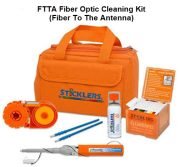
Stickler FTTA Fiber To The Antenna Cleaning Kit @ eBAY

Visit Wet/Dry Cleaning Solutions for adapter cleaning and end-face cleaning for more product info or more of "My World" for more application notes
Use the MENU Above ... Email or call if you have questions